
| Peso | 484 g |
|---|---|
| Dimensões | 2 × 14 × 22 cm |
| Condição | |
| Formato | |
| Ano | |
| Idioma |
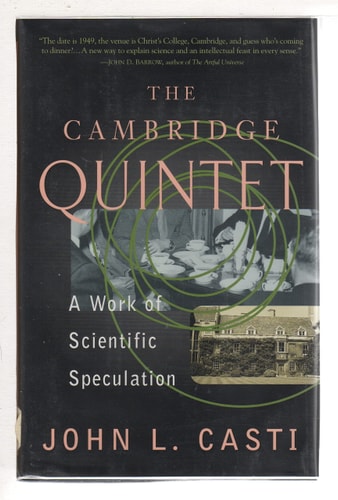
The Cambridge Quintet: A Work Of Scientific Speculation
R$77,50
LIVRO
- Autor: John L. Casti
- Editora: Helix Books/Addison Wesley
- Qtd. Páginas: 181
- Isbn: 9780201328288
- Código Estoque: 388766A
1 em estoque
In this narrative tour de force, gifted scientist and author John L. Casti contemplates an imaginary evening of intellectual inquirya sort of My Dinner with” not Andre, but five of the most brilliant thinkers of the twentieth century.Imagine, if you will, one stormy summer evening in 1949, as novelist and scientist C. P. Snow, Britain’s distinguished wartime science advisor and author of The Two Cultures, invites four singular guests to a sumptuous seven-course dinner at his alma mater, Christ’s College, Cambridge, to discuss one of the emerging scientific issues of the day: Can we build a machine that could duplicate human cognitive processes? The distinguished guest list for Snow’s dinner consists of physicist Erwin Schrodinger, inventor of wave mechanics; Ludwig Wittgenstein, the famous twentieth-century philosopher of language, who posited two completely contradictory theories of human thought in his lifetime; population geneticist/science popularizer J.B.S. Haldane; and Alan Turing, the mathematician/codebreaker who formulated the computing scheme that foreshadowed the logical structure of all modern computers. Capturing not only their unique personalities but also their particular stands on this fascinating issue, Casti dramatically shows what each of these great men might have argued about artificial intelligence, had they actually gathered for dinner that midsummer evening.With Snow acting as referee, a lively intellectual debate unfolds. Philosopher Wittgenstein argues that in order to become conscious, a machine would have to have life experiences similar to those of human beingssuch as pain, joy, grief, or pleasure. Biologist Haldane offers the idea that mind is a separate entity from matter, so that regardless of how sophisticated the machine, only flesh can bond with that mysterious force called intelligence. Both physicist Schrodinger and, of course, computer pioneer Turing maintain that it is not the substance, but rather the organization of that s