
| Peso | 690 g |
|---|---|
| Dimensões | 2 × 15 × 23 cm |
| Condição | |
| Formato | |
| Ano | |
| Idioma |
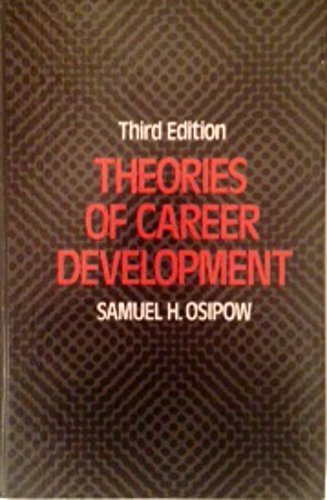
Theories of Career Development
R$30,00
LIVRO
- Autor: Samuel H. Osipow
- Editora: Prentice Hall
- Qtd. Páginas: 338
- Isbn: 0139136401
- Código Estoque: 261163A
1 em estoque
Since the earliest memories of human beings, we have been impelled to earn our daily bread. The meaning and variety of the work in which we have engaged vary enormously depending on our talents, our circumstances, and our cultural context. However, the generally dismissive attitude held toward work has not changed. In the West, the need to work long and hard enough in any way. To be sure, work has always been a central human concern, and it has always been socially recognized that more is accomplished by one’s ability and industry than by inherited wealth. Certainly, the attitudes toward work derived from work in Western cultures despite our chronic complains.
As one attempts to define work it becomes increasingly clear that definitions confound and complicate rather than clarify the multiple behaviors involved. Work is partly an attitude in the mind of a person toward the activity in which he or she is engaged at the moment. One person’s work is another’s play. It is clear that working holds an important place both in society and in the psychological lives of individuals.
A second consideration is that in Western society at least, we possess an element of choice concerning the activity with which we will occupy ourselves. Through the variety of work from which we may choose varies from person to person and from time to time, it is true that we decide what kind of work we will do, for whom, and when. Although always extreme the potential of choice is highly valued. It is not surprising in a society in which many people have the opportunity to choose their careers and in which the broad significance of work is recognized, that attempts to understand the decision-making processes involved in career development.